Personal stylist app
Personal stylist app
Style Sync is a personal styling app that connects users with professional stylists for personalized online consultations. Stylists create curated outfits based on each user’s preferences and organize them in a digital closet with direct shopping links, making it easy to discover and buy new pieces.
The goal was to create a clean, premium experience that makes personal styling feel simple, accessible, and enjoyable. In this case study.
Style Sync is a personal styling app that connects users with professional stylists for personalized online consultations. Stylists create curated outfits based on each user’s preferences and organize them in a digital closet with direct shopping links, making it easy to discover and buy new pieces.
The goal was to create a clean, premium experience that makes personal styling feel simple, accessible, and enjoyable. In this case study.


Role: UX/UI Designer
Role: UX/UI Designer
Skills: competitor analysis, user interview, usability testing, ui design
Skills: competitor analysis, user interview, usability testing, ui design
Duration: 2 months
Duration: 2 months
Problem Statement
?
Difficult to decide what wear: Users often make spontaneous purchases and spend extra money on clothes they don't wear because they don't know what clothes fit and how to combine them properly.
?
“Why I need a stylist?”: Users don't use a stylist because they think it's too expensive and don’t understand how it works.
?
The need for advice: Users want advice and approval, they find it difficult to decide to buy as they don't want to spend money and time on clothes they won't wear.
?
Best price: Users spend a lot of time searching for clothes because they want to find the Best price and not spend extra money.
?
Expertness: Users want to get an expertl and affraid to waste time and money.
Solution
Difficult to decide what wear: Users often make spontaneous purchases and spend extra money on clothes they don't wear because they don't know what clothes fit and how to combine them properly.
“Why I need a stylist?”: Users don't use a stylist because they think it's too expensive and don’t understand how it works.
The need for advice: Users want advice and approval, they find it difficult to decide to buy as they don't want to spend money and time on clothes they won't wear.
Best price: Users spend a lot of time searching for clothes because they want to find the Best price and not spend extra money.
Expertness: Users want to get an expertl and affraid to waste time and money.
Goal
Goal
To provide an affordable way to get expert fashion advice, helping users refine their style, save time, and avoid unnecessary purchases.
Stakeholder Interview
After I conducted the competitive analysis to better understand the market I conducted an interview with a stylist to realize how she provides such as services and how it works online.
Conducting a questionnaire
"I conduct a questionnaire, before calling the client, and also ask the client to send a photo in lingerie (snaps)"
Defining budget boundaries
"We usually set a budget for each product group.I'm always interested in what brands people wear, it helps me determine the approximate budget for clothes"
Finding a perfect fit
"Customers can send photos or call in with a video to show how the clothes look on them, if they don't like a particular model I find something similar from another brand."
Lack of information
"It is very annoying to have a customer who orders a service and does not want to give information. When there is a lack of information and you don't know what to do with people"
Presentation of the solution
"I usually present collections in the form of presentation with a guide how to use it.
A presentation is something a person pays money for"
Target audience
“My target audience is mostly women 24-38 years old, with an income of 3,000 euros or more.”

Anna Pustovalova
Personal stylist, Influencer
Survey
I got 52 responses with different demographics, the results were very helpful.
52%
52%
(25 out of 48)
(25 out of 48)
Prefer to buy clothes, while comparing prices across different websites to find the best deal.

79%
79%
(41 out of 51)
(41 out of 51)
define the budget for new clothes in advance.

67%
(35 out of 51)
want to define their preferences when filling out their profile.

User Interviews Key Insights
After conducting 6 interviews I made affinity maps, after analyzing the data I identified the following insights.
Budget for new clothes
5 of 6 participants define the budget for new clothes in advance
“I estimate the budget for everything, according to the brand. for example, jeans in COS for €100 are ok, in H&M - not ok.”
Looking for the best price
4 of 6 participants searching for the best price solutions when buying clothes
“I look for clothes on Farfetch, but
I don't buy them because they are very costly. But of course, you can find something cheaper in another store”
Spontaneous purchases
4 of 6 participants waste money on clothes they don't wear
“I often buy things that don't fit me and
I know about it, then when I put them on, I get annoyed and don't use them anymore”
How to combine clothes
5 of 6 don’t know what clothes suits them and how to combine clothes
“I don't have a picture in my head of how to combine things, I just go and buy something, and then all the things look different and you don't understand how to choose the right outfit”
Need for confirmation
6 of 6 not sure that the clothes they bought fit them before they got approval
“I just need a confirmation from someone (mom or friend) to buy this or that thing, even though their opinion is not very authoritative.”
Safe personal style
5 of 6 participants define the budget for new clothes in advance
“I want to step out of my style. But it's important for me not just to change my style, but to adapt it to my style. I want to be me”

Prototyping
Wireframes.
Wireframes.
Wireframes.
High fidelity prototypes
High fidelity prototypes
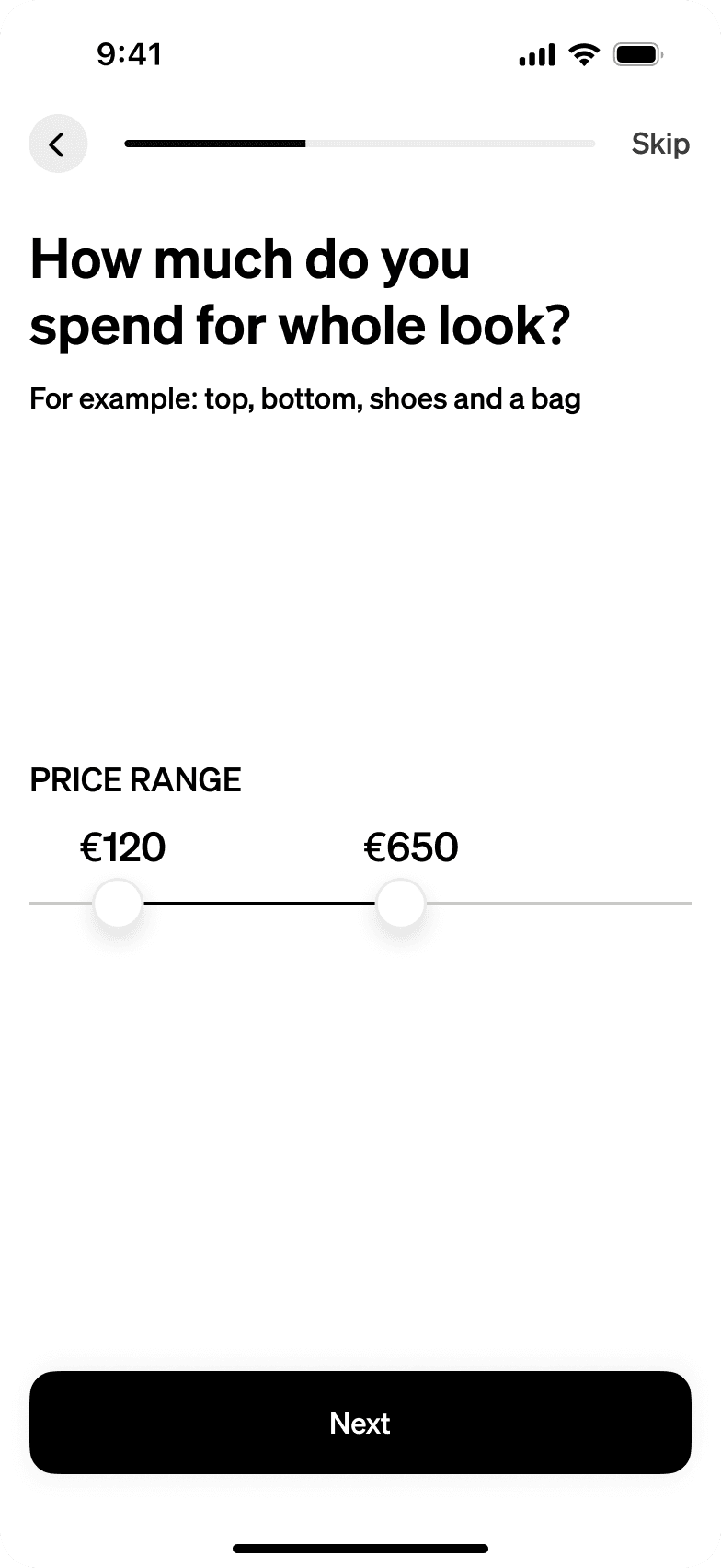
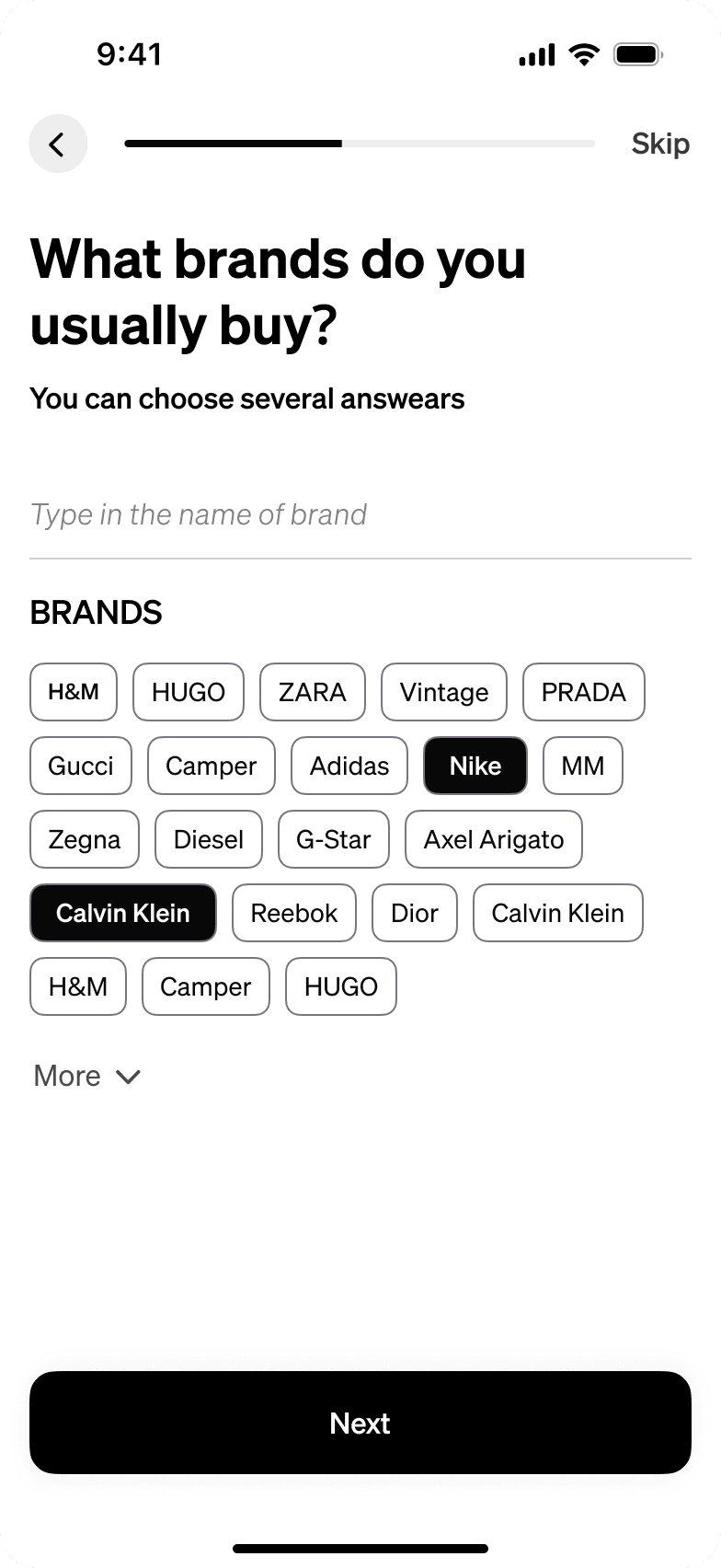
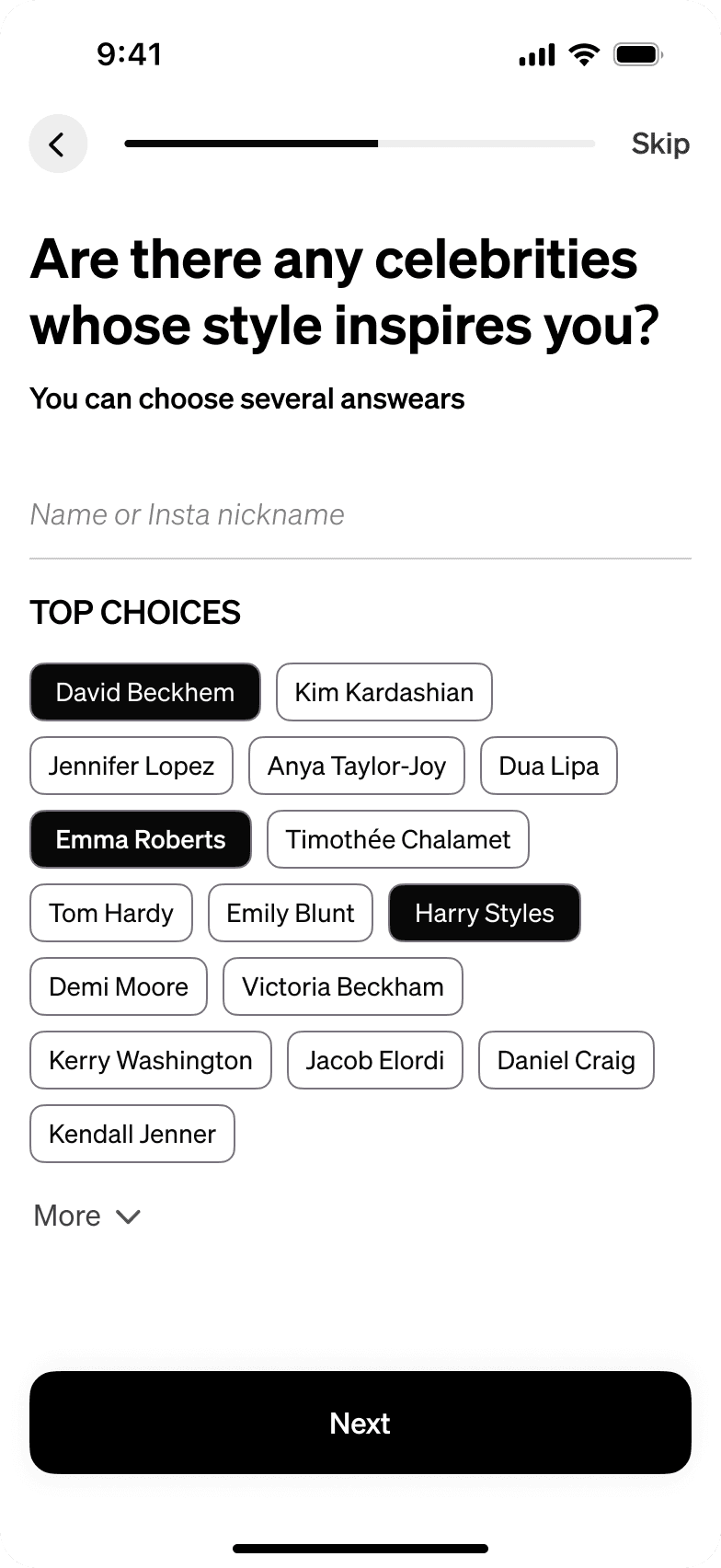
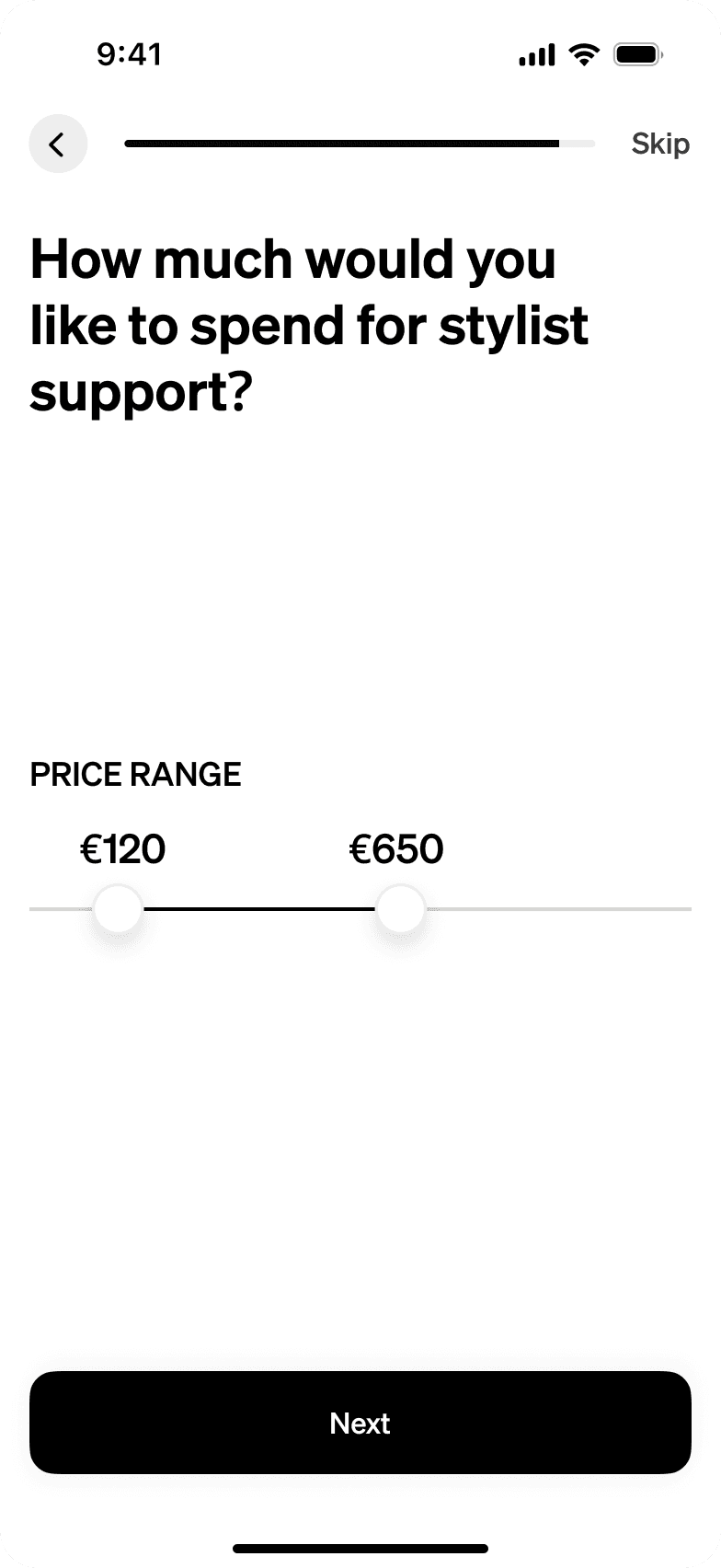
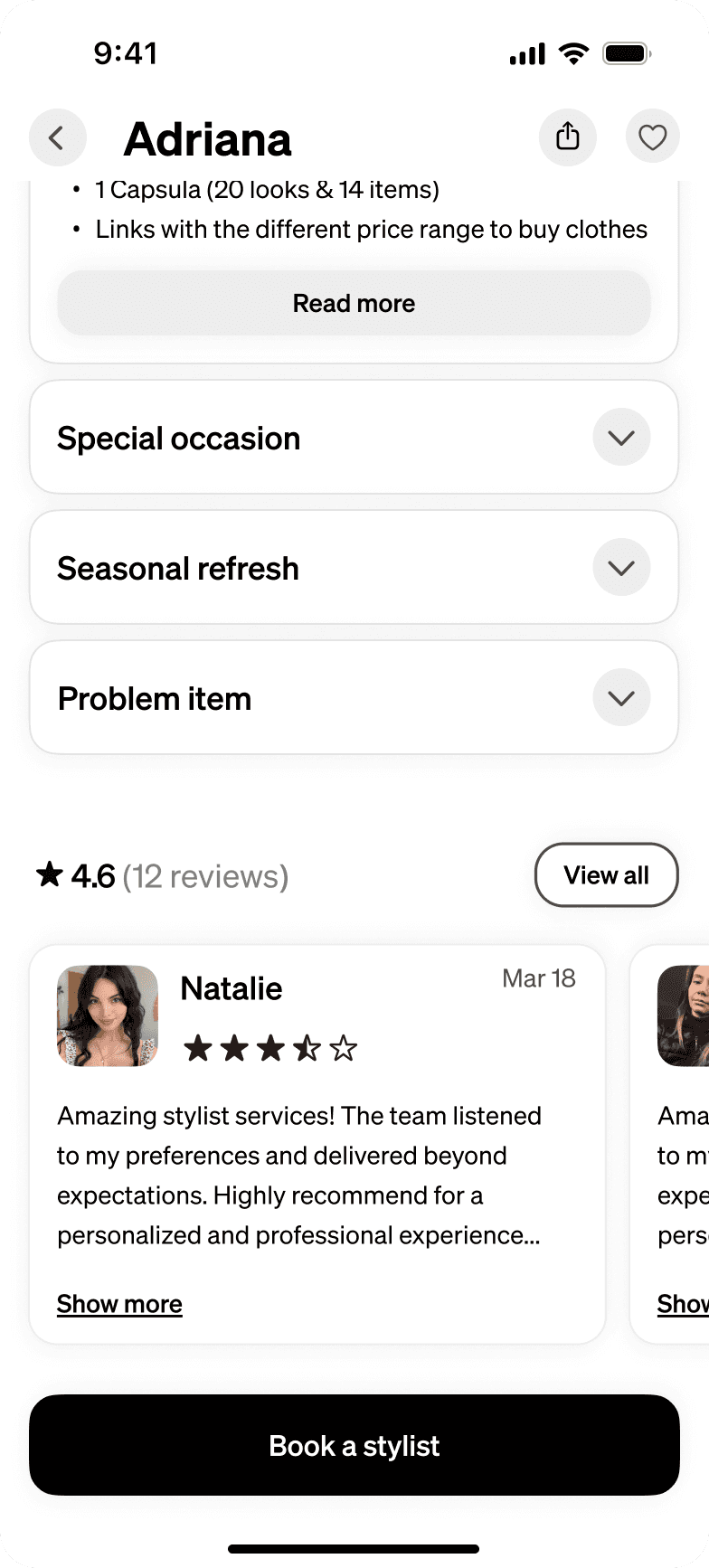
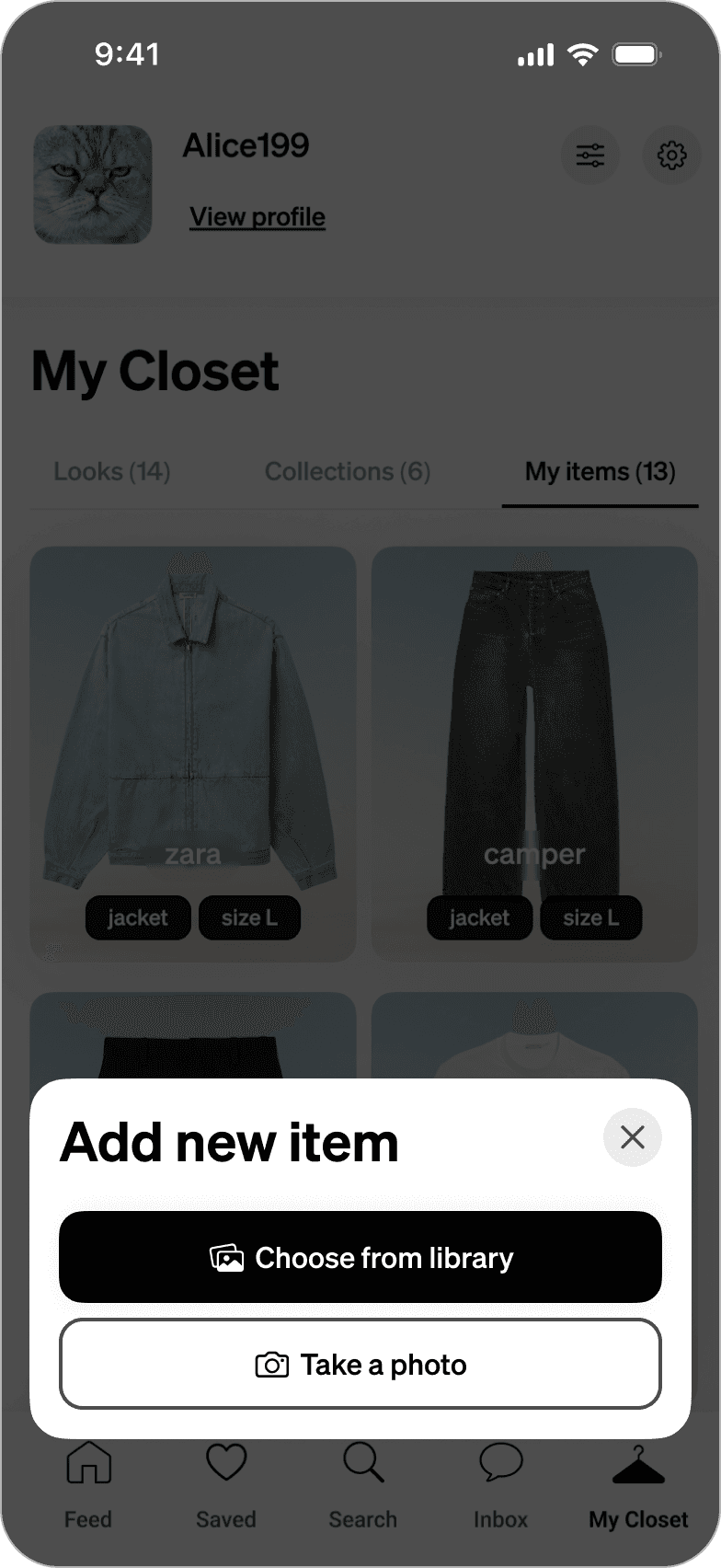
With the structure finalized, I focused on visual refinement. Every screen was detailed with consistent components, carefully selected colors, typography, and spacing to create a cohesive and intuitive interface.
With the structure finalized, I focused on visual refinement. Every screen was detailed with consistent components, carefully selected colors, typography, and spacing to create a cohesive and intuitive interface.
Onboarding/Survey
Onboarding/Survey





Find stylist
Find stylist


My Closet
My Closet




Inbox
Inbox


Usability Testing
To validate the design, I conducted moderated usability tests with participants both remotely and in person. The insights were synthesized using an affinity map and a rainbow spreadsheet, helping me uncover common pain points, prioritize issues, and iterate on the design based on real user feedback.
The difference between
“My items” and “Items”
The difference between
“My items” and “Items”
4 of 6 participants didn’t realize what is the difference and for what “My items”
4 of 6 participants didn’t realize what is the difference and for what “My items”
"Not sure what “My Items” means and what is the difference with “Items”?
My Closet
My Closet
5 of 6 participants confusing by navigation on the "My Closet" tab
5 of 6 participants confusing by navigation on the "My Closet" tab
“Was hard to realize how "My Closet tab" works”
How to use Guides?
How to use Guides?
4 out of 6 participants didn’t realize how to use Guides and what is it
4 out of 6 participants didn’t realize how to use Guides and what is it
“I totally don't understand
what is going on here ”
Design solutions
Design solutions
As we can see, all the problems are related to “My Closet” tab.
As we can see, all the problems are related to “My Closet” tab.
Provide more information to the user, add a subheaders, change the design inside similiar tabs to enhance recognition.
Enhance the recognition, to rename elements with clear names and provide more information to the user.
Make collections different inside to get rid of tabs inside the collection.
Create a main page for each collection to implement guides there.
Provide more information to the user, add a subheaders, change the design inside similiar tabs to enhance recognition.
Enhance the recognition, to rename elements with clear names and provide more information to the user.
Make collections different inside to get rid of tabs inside the collection.
Create a main page for each collection to implement guides there.
My Closet
My Closet

Before
Before
The main problem is recognition and that the tabs look similar
Lack of information and context
UX writing, unclear names
The main problem is recognition and that the tabs look similar
Lack of information and context
UX writing, unclear names

After
After
The main page for collection serves as presentation, and provides rapid access to the all categories. The understanding of guides increased, they became clear in the context of collection.
The main page for collection serves as presentation, and provides rapid access to the all categories. The understanding of guides increased, they became clear in the context of collection.
Guides
Guides

Before
Before
Guides serve to explain client how to use collection, how to combine items, colors, etc. The flow was longer, content wasn’t real, it was hard realize for user what is it,and why it belongs to collection.
Guides serve to explain client how to use collection, how to combine items, colors, etc. The flow was longer, content wasn’t real, it was hard realize for user what is it,and why it belongs to collection.

After
After
The main page for collection serves as presentation, and provides rapid access to the all categories. The understanding of guides increased, they became clear in the context of collection.
The main page for collection serves as presentation, and provides rapid access to the all categories. The understanding of guides increased, they became clear in the context of collection.
Conclusion
Conclusion
The goal of this project was to create an affordable, fast stylist consultation service with a user-friendly interface. Through thorough user research, persona creation, and iterative prototyping, I turned the initial concept into
a refined solution.
A key challenge was simplifying the complex "Digital Closet" navigation. Usability testing and card sorting helped develop a more intuitive, functional interface. The final design reduced task times, minimized errors, and increased user satisfaction, greatly improving the overall experience.
This project highlighted the value of iterative design and user feedback. Moving forward, the focus will be on enhancing communication with stylists and developing features like online calls and subscription payments.
The goal of this project was to create an affordable, fast stylist consultation service with a user-friendly interface. Through thorough user research, persona creation, and iterative prototyping, I turned the initial concept into
a refined solution.
A key challenge was simplifying the complex "Digital Closet" navigation. Usability testing and card sorting helped develop a more intuitive, functional interface. The final design reduced task times, minimized errors, and increased user satisfaction, greatly improving the overall experience.
This project highlighted the value of iterative design and user feedback. Moving forward, the focus will be on enhancing communication with stylists and developing features like online calls and subscription payments.